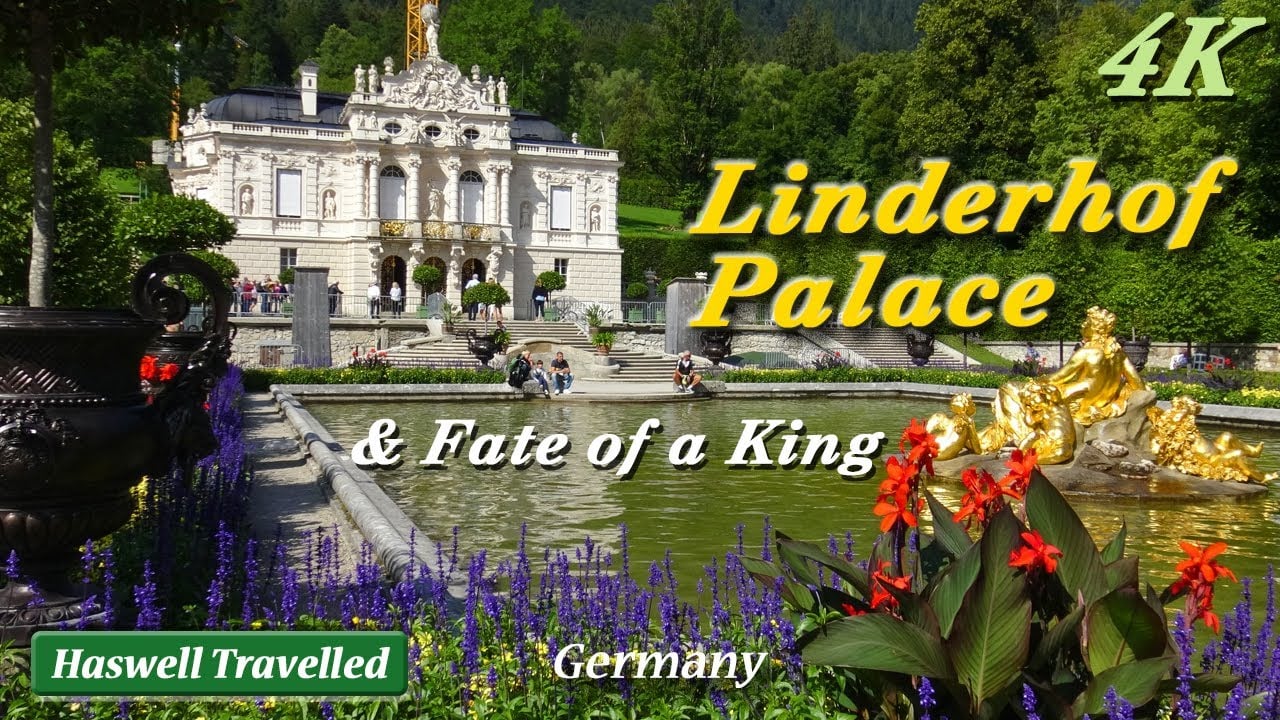
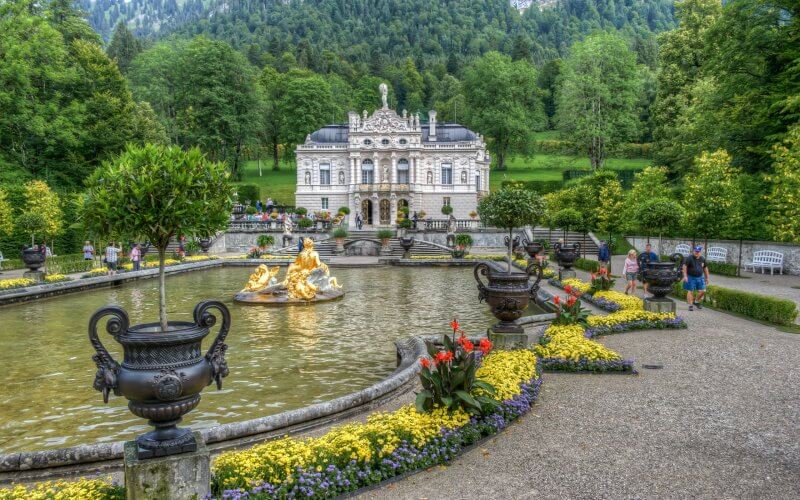
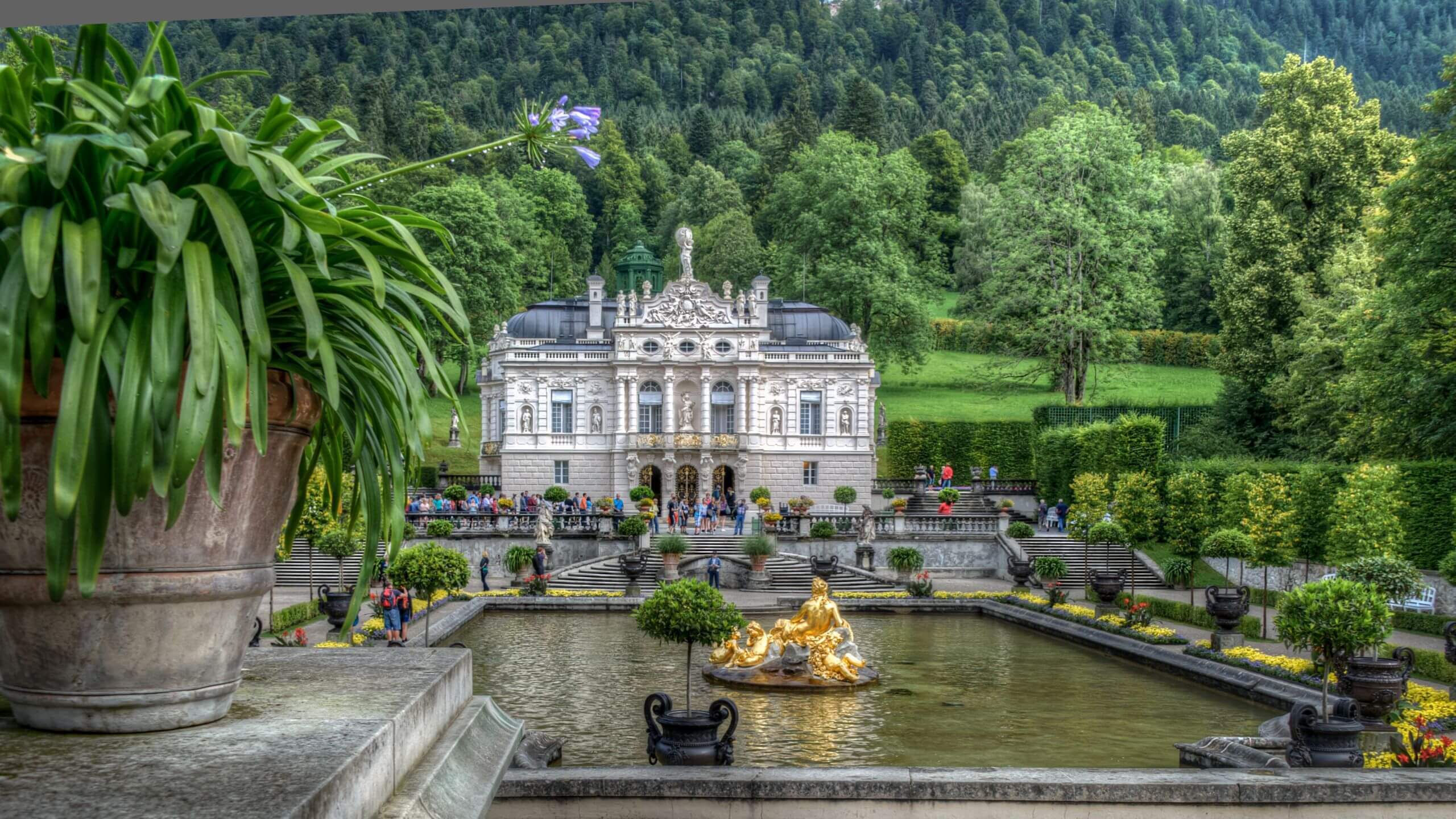
Linderhof Castle is one of the three famous German castles located in the picturesque mountains of Bavaria. It is the smallest and most “homely” residence of King Louis II, with its main attractions being the Grotto of Venus and the English Garden.
General information
Linderhof Castle is located in Upper Bavaria (Germany), and is one of the many residences of King Louis II. The attraction is located 30 km from Garmisch-Partenkirchen and 8 km from the small village of Oberammergau.
The castle’s location is extremely convenient for tourists, as the famous castles of Neuschwanstein and Hohenschwanau are only 20 kilometers away.
The Lindenhof Castle in Germany is famous not only for its luxurious interiors, but also for its large garden, which is located in the mountains. Louis himself often referred to it as the “Residence of the Swan Prince,” while members of the royal family referred to it as the “Temple of the Sun.” The peacock is considered the symbol of the Lindenhof Castle in Bavaria, and its statues can be found in many of the castle’s rooms.
Brief history
Maximilian of Bavaria (Louis II’s father) was a great traveler, and while visiting Upper Bavaria, he saw a small hunting lodge in the mountains. As the king was a great hunter, he purchased the small building and its surrounding land.

Almost 15 years later, Maximilian’s son, Louis II, decided to build a castle in Germany similar to Versailles (the king himself designed the sketches for the future interiors). The location for the future residence was chosen to be very picturesque: mountains, a pine forest, and several small mountain lakes nearby.
However, at the initial stage of construction, it became clear that there would not be enough space for such a grandiose project. As a result, the construction of Versailles continued in Herrenchiemsee (Germany). In Upper Bavaria, it was decided to build a small, secluded palace where the king could visit with his family.
The King’s residence in Bavaria was built over a period of more than 15 years. Local types of wood were used for the decoration of the interiors and the production of furniture, and the walls and ceilings of the castle are also made entirely of wood and plastered.
Architecture and interior decoration
The Linderhof Castle in Germany was built in the rare style of Bavarian Neo-Rococo, and it seems quite small compared to the famous Neuschwanstein and Hohenschwanagau castles. The castle consists of only two floors and five rooms, which were built exclusively for Ludwig II. There are no guest rooms or an office where the king could receive guests.
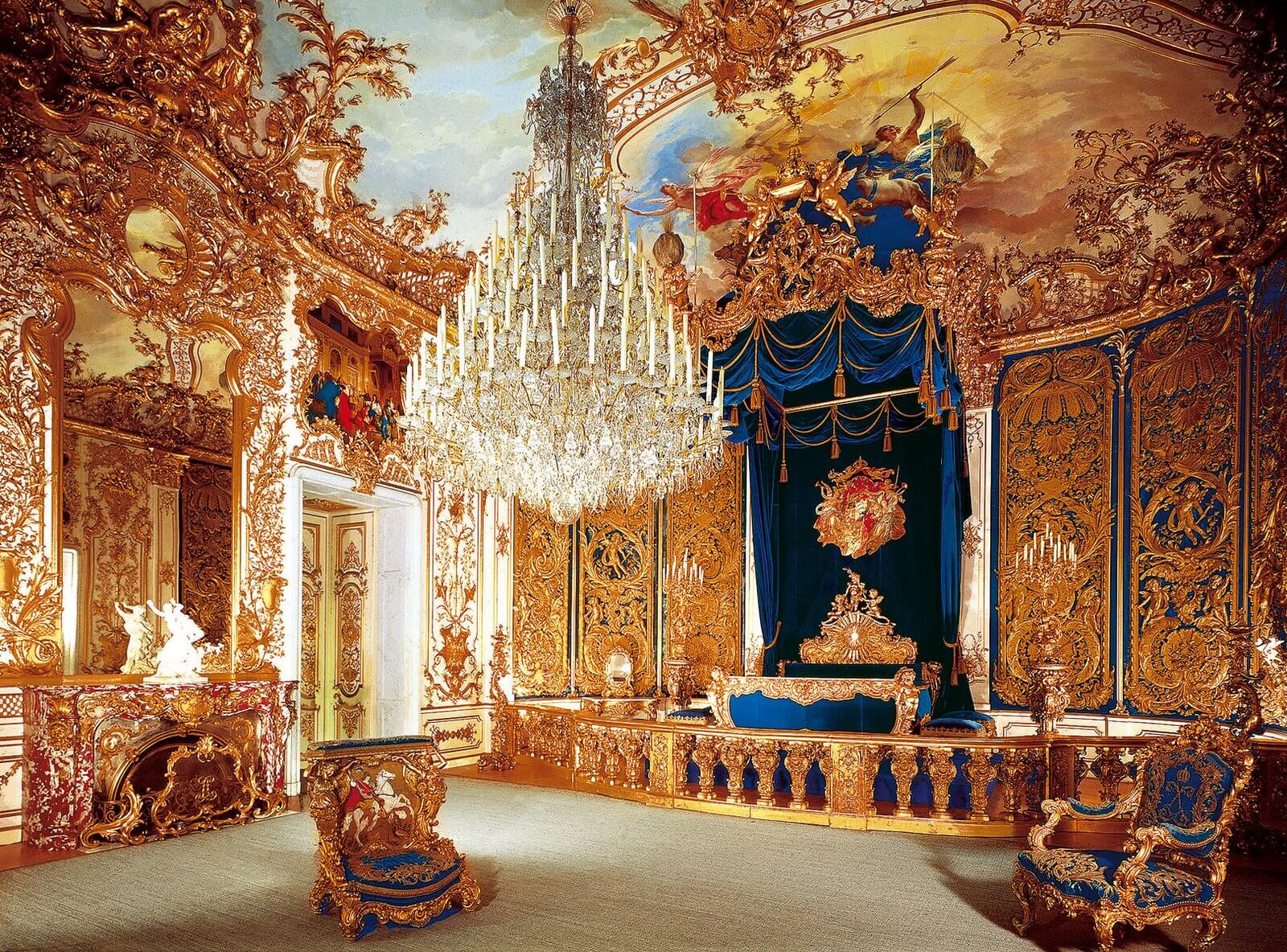
Since the Lindenhof Castle in Bavaria was intended exclusively for the king and his family, there are very few halls and bedrooms:
- The bedroom of the “King of the Night”. This is the largest room in the house, which only Louis II was allowed to enter. The walls are decorated with gilded paintings and frescoes, and in the center of the room stands a huge four-meter bed with a velvet canopy and gilded legs. Interestingly, this interior was designed by a theater artist.
- The Mirror Hall is a small room in the eastern part of the castle, which, however, looks no less than a bedroom, since mirrors hang on both walls and ceilings. They reflect hundreds of candles and golden bas-reliefs, creating an inexpressible atmosphere of mystery and fantasy.
- The Tapestry Hall was used as a museum, which contained a large collection of tapestries and furniture that Louis had brought from various countries.
- The reception hall is the king’s office, where he conducted state affairs from behind a massive malachite table (a gift from the Russian emperor).
- The dining room is the most modernized room in the castle. Its main feature is a table that works like an elevator: it is set up in the basement and then lifted to the top. Louis II was very pleased with this device, as he was an unsociable person who preferred to dine alone. The servants said that the king always requested a table for four, as he dined with imaginary friends, including Marie de Pompadour.
The king was very proud of being a member of the Bourbon dynasty, so there are many coats of arms and lilies (their symbol) in all the rooms. However, there are no images of swans (the symbol of Louis himself) in the Bavarian castle, as the king believed that his grandeur and power should be represented by his other residence, the Château de la Belle-Étoile.
Linderhof Gardens
Since Louis originally wanted to build the Linderhof Palace in Bavaria in the style of Versailles, a lot of attention was paid to the gardens and the entire area around the palace. On a 50-hectare plot, the best gardeners from France, England, and Germany created flower beds and a picturesque English garden.
Walking around the park, you can see about 20 fountains, 35 sculptures, and several unusual gazebos. In addition, the gardens feature:
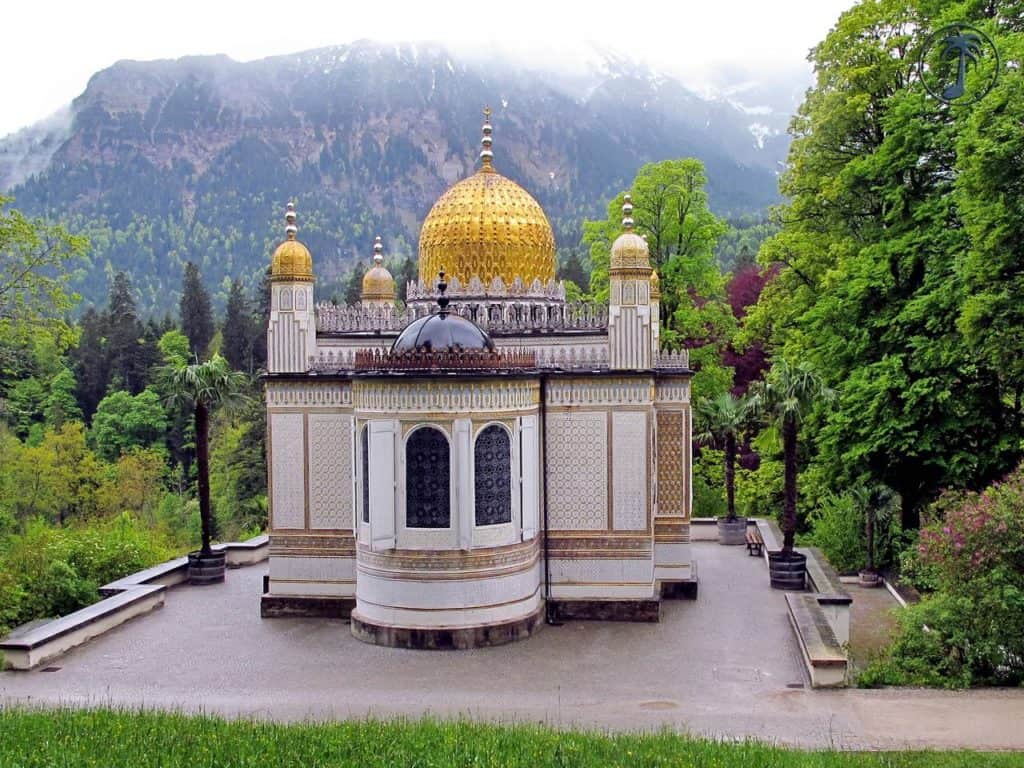
- The Marrakech House. It is a small but very beautiful building in the center of the garden. Inside, you can find dozens of oriental carpets and rare types of fabrics.
- Handing’s Hut. A hunting lodge built as a setting for one of the operas. The rooms are decorated with bear skins, bird taxidermy, and weapons.
- The hunting lodge. The very house that Maximilian of Bavaria saw and decided to buy the land.
- The Moorish Pavilion. A small building in the western part of the garden, built in the oriental style (early 19th century). Inside, there are marble walls, paintings in gold frames, and a large peacock throne that was brought to Germany in the late 19th century.
Like his father, Louis was very fond of opera and admired the works of Richard Wagner (he was a frequent guest in Bavaria), for listening to whose works the Grotto of Venus was erected – a symbol and the main attraction of the Linderhof Castle. The acoustics in this small underground room were simply amazing, and the king loved to spend his free time here.
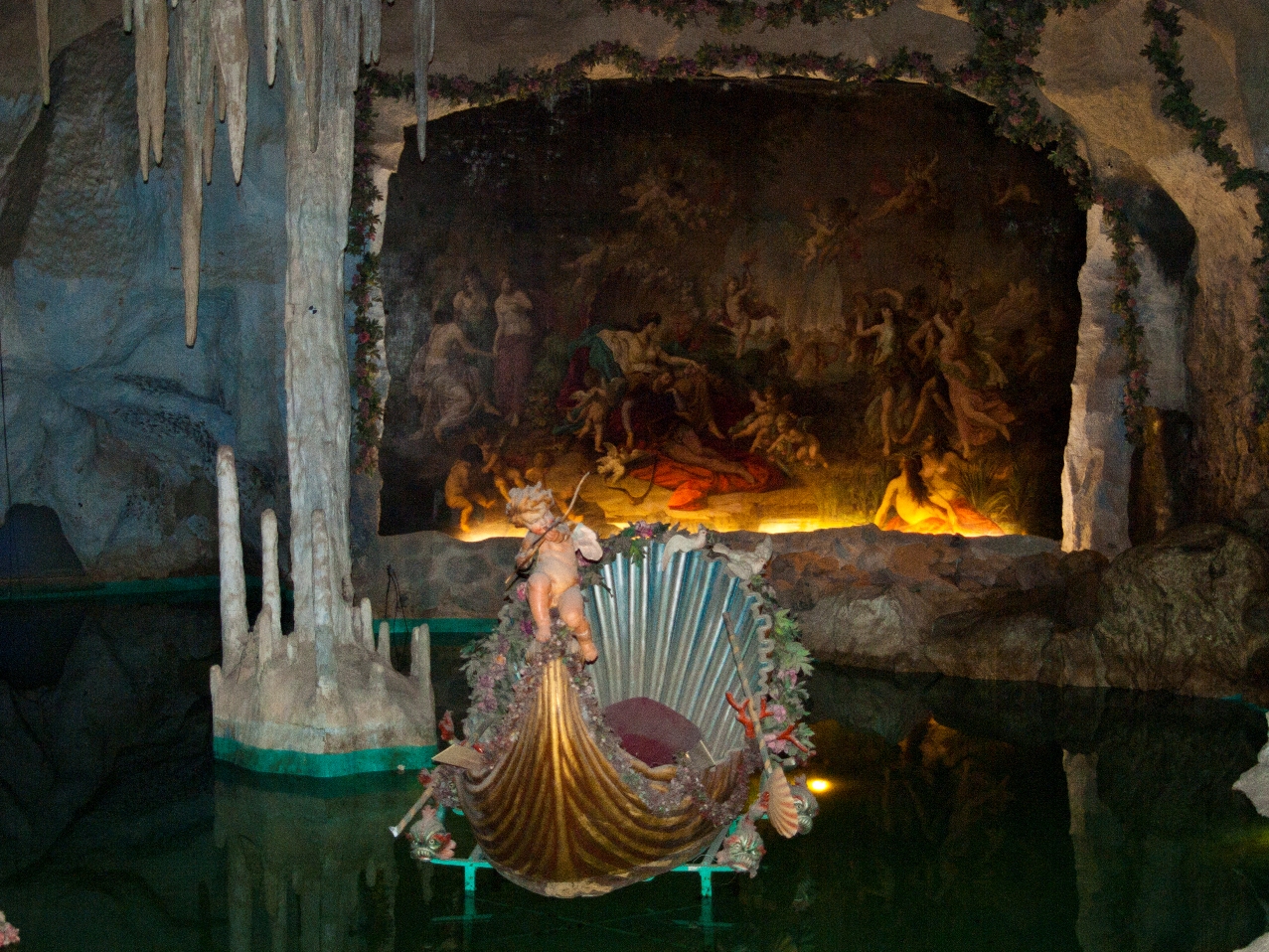
Interestingly, it was in this grotto that the first devices used in theatrical productions today were introduced in Germany: color-changing light bulbs, sound equipment, and smoke machines.
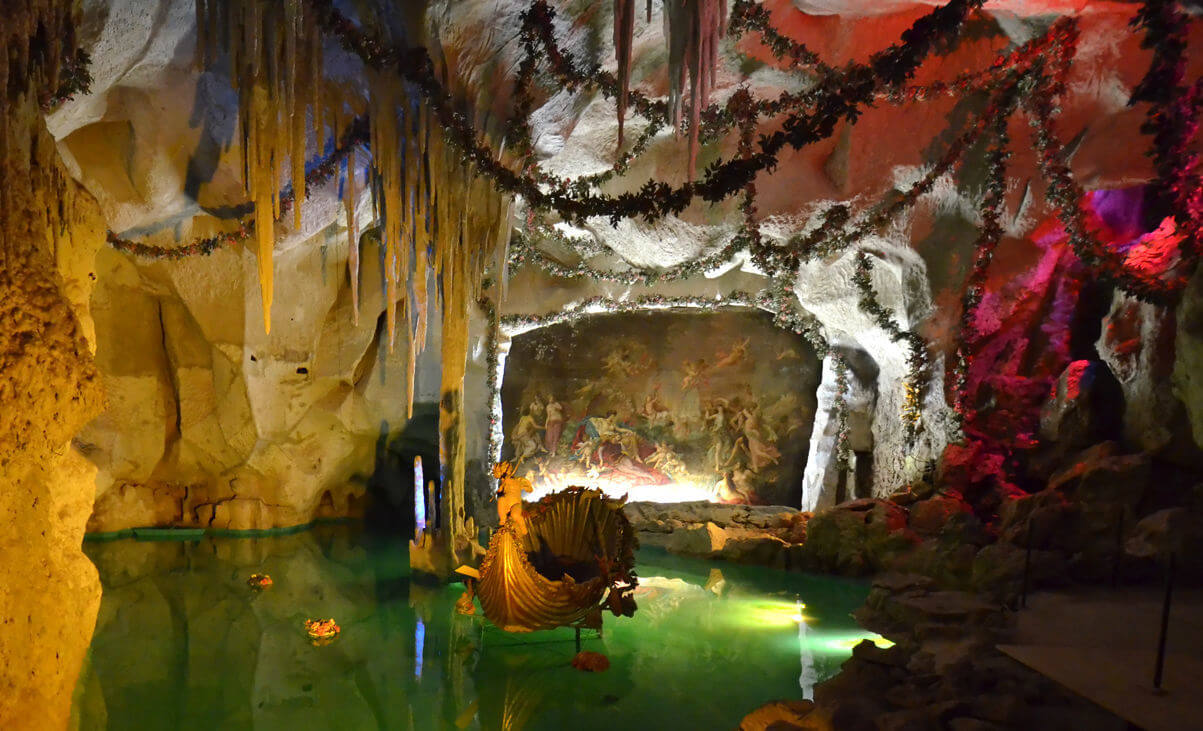
In the central part of the grotto, there is a fountain and a small lake. These two settings were perfect for the production of Tannhäuser, which Louis loved so much.
How to get there from Munich
Linderhof Castle and Munich are separated by 96 km. Unfortunately, it is not possible to reach your destination without transfers. There are 3 options:

- You need to take the R-Bahn train from Munich Central Station to the village of Oberammergau in Bavaria (ticket price: 22-35 euros, travel time: just over an hour). The train runs 3-4 times a day. Then, you need to take a bus to the attraction (ticket price: 10 euros). The total travel time is 2.5 hours.
- You can also get to the attraction by transferring in the German city of Murnau. You need to take a train from Munich Central Station to Murnau (price: 19-25 euros, travel time: 55 minutes). Then, transfer to a train to the village of Oberammergau (price: 10-15 euros, travel time: 25 minutes). The remaining distance (10 km) can be covered by taxi (about 20 euros) or by bus (10 euros). The total travel time is 2 hours. Trains run every 2-4 hours.
- You must take a Flixbus bus at Munich’s main bus station (running 4 times a day). Get off at the Garmisch-Partenkirchen bus stop (travel time is 1 hour and 20 minutes). The rest of the way (about 30 km) will have to be done by taxi. The cost of the bus is 4-8 euros. The price for a taxi ride is 60-65 euros. The total travel time is 2 hours.
Thus, in response to the question of how to get to Linderhof Castle from Munich, we can unfortunately say that the only way to reach the castle quickly and comfortably is by taxi. Other options are cheaper, but they require at least one transfer.
You can buy train tickets either at the railway station ticket office or at special vending machines that are located at railway stations in Germany. By the way, it is more profitable to buy tickets at vending machines – you can save 2 euros.
Flixbus bus tickets can be purchased on the official website: www.flixbus.de. Here you can also follow new promotions (they are held very often) and company news.
Practical information
- Address: Linderhof 12, 82488 Ettal, Bavaria, Germany.
- Opening hours: 9:00 – 18:00 (April – September), 10:00 – 16:00 (October – March).
- Cost of visit (euro):
| All points of interest | Royal Lodge | Palace | Park | |
|---|---|---|---|---|
| Adults | 8.50 | 2 | 7.50 | 5 |
| Pensioners and students | 7.50 | 1 | 6.50 | 4 |
Admission is free for people under 18.
The cost of a general ticket (Linderhof + Neuschwanstein + Hohenschwanau castles) is 24 euros. This ticket is valid for 5 months after purchase, and it can be purchased at any of the above-mentioned castles in Germany or online.
Official website: www.schlosslinderhof.de
Useful tips
- The tour is already included in the ticket price. Unfortunately, it is not possible to visit the castle without a guide, as there are many people who want to see Louis’s residence. However, it is possible to visit the park without an escort. Please note that the guide only speaks English and German.
- Spend a whole day visiting the castles of Linderhof, Neuschwanstein, and Hohenschwanagau – you won’t be disappointed.
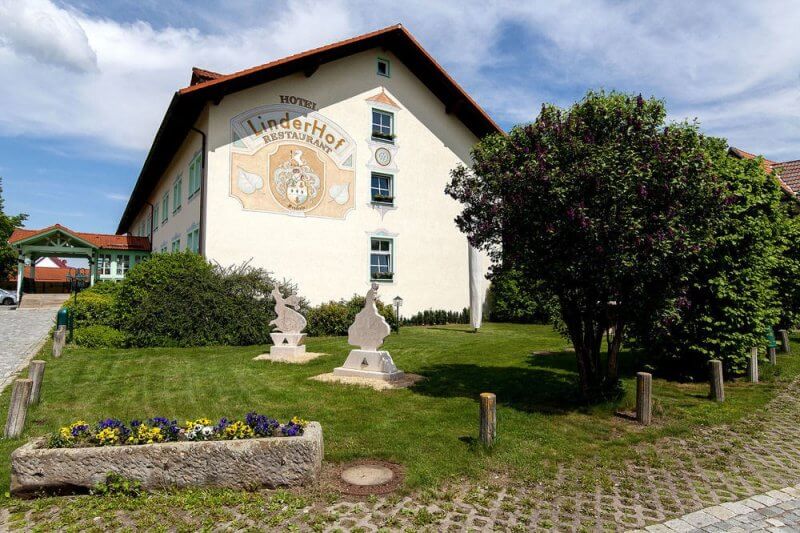
- If you are captivated by the beauty of Linderhof Castle, you can stay overnight at the hotel of the same name (Schloßhotel Linderhof 3*), just a few kilometers away.
- Please note that photos are not allowed at Linderhof Castle (the same applies to Neuschwanstein and Hohenschwanau castles).
Linderhof Castle in Bavaria (Germany) – the smallest, but the most original and original residence of Louis II.